Condensation
What Is the Ideal Indoor Humidity for a Home?
Keeping indoor humidity in a sensible range is the quiet secret to avoiding condensation and mould. Here is what 'ideal' means and how to measure and manage it.
In short
A comfortable indoor relative humidity is commonly cited as roughly 40–60%, offered here as general guidance rather than a strict rule. Below this, air can feel dry; sustained levels well above it make condensation and mould much more likely. Measure yours with an inexpensive hygrometer, ideally in more than one room.
Key takeaways
- Around 40–60% relative humidity is commonly cited as a comfortable range (general guidance, not a strict rule).
- Relative humidity depends on temperature, so the same amount of moisture reads differently in a cold room.
- An inexpensive hygrometer lets you measure humidity room by room.
- Sustained high humidity is the condition mould needs to take hold.
- Ventilation, heating and moisture control bring high humidity back down.
If you want one number to keep an eye on in the fight against condensation and mould, it is indoor humidity. Keep it in a sensible range and most damp problems never get started.
What 'ideal' humidity actually means
Humidity is usually measured as relative humidity (RH) — the percentage of moisture the air is holding compared with the maximum it could hold at that temperature.
A comfortable indoor relative humidity is commonly cited as roughly 40–60%. Treat this as general guidance rather than a precise target: it is a sensible band that tends to feel comfortable and keeps surfaces clear of condensation, not a hard line where everything changes at 61%.
- Below about 40% the air can start to feel dry.
- Above about 60%, sustained, you move into the territory where condensation and mould become much more likely.
Why temperature changes everything
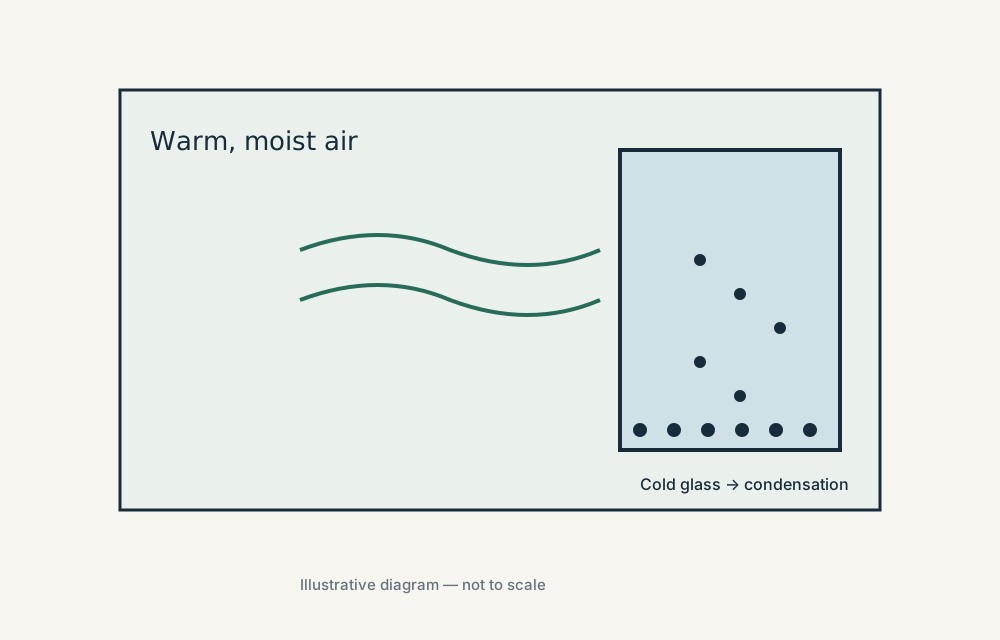
Relative humidity is relative to temperature, and this trips people up. Warm air holds more moisture than cold air, so the same amount of water vapour gives a lower RH reading in a warm room and a higher one in a cold room.
This is why a cold spare bedroom can show high humidity and grow mould even though the rest of the house seems fine, and why warming a room a little can bring its RH down without adding or removing any water. Understanding this link is also the heart of the dew point — see what causes condensation.
Tip
To see how close your room is to the point where condensation forms, feed your temperature and humidity into the dew point calculator.
How to measure it with a hygrometer
A hygrometer is a small, inexpensive device — often combined with a thermometer — that displays the relative humidity in a room.
- Place it away from direct influences — not next to a radiator, a window, a kettle or an open bathroom door.
- Let it settle for a while before reading, as these devices take time to catch up with the room.
- Measure more than one room. Bedrooms, bathrooms and the coldest rooms often tell the real story.
- Watch the trend, not a single reading. Humidity swings through the day — after a shower, while cooking, overnight. A persistent high baseline is what matters.
The humidity tracker helps you log readings over time so you can spot patterns and check whether your changes are working.
What the readings are telling you
| Relative humidity | What it usually means |
|---|---|
| Below 40% | On the dry side; generally fine, humidify only if uncomfortable |
| 40–60% | Commonly cited comfortable range |
| 60–70% | Getting high; improve ventilation and watch cold surfaces |
| Above 70% sustained | Strong risk of condensation and mould; act promptly |
Short spikes — straight after a shower, for example — are normal. It is a sustained high reading that signals a problem.
How to bring high humidity down
If your readings sit too high, the levers are the same as for condensation generally:
- Ventilate to replace humid air with drier air.
- Heat consistently so surfaces stay warm and RH does not spike in cold rooms.
- Reduce moisture at source — indoor drying, lids on pans, extractor fans.
- Add a dehumidifier where ventilation cannot keep up.
The full approach is set out in how to stop condensation.
When humidity is too low
It is far less common in UK homes, but very dry air (well below 40%) can feel uncomfortable. It is usually a winter effect of heating cold, dry outdoor air. A bowl of water, houseplants or a humidifier can nudge it up — though for most UK households the challenge is reducing humidity, not adding it.
Try a related tool
Frequently asked questions
Mould is favoured by sustained high humidity and damp surfaces. Keeping indoor relative humidity broadly within the commonly cited 40–60% range and avoiding prolonged readings above about 70% makes it far less likely to take hold.
Sources
- NHS: Can damp and mould affect my health? · UK · accessed 27 October 2026
- GOV.UK: Understanding and addressing the health risks of damp and mould in the home · England · accessed 27 October 2026
DampSense Editorial Team
Research & editorial
Our editorial team researches UK building-moisture topics using government guidance, public-health sources and established building-science references. We write to help homeowners and tenants make informed decisions, and we flag where professional assessment is needed.
Credentials & limitations: Research-led editorial team. We are not chartered surveyors; our guides are general information, not a professional building survey.