Condensation
What Causes Condensation in a Home?
Condensation is a simple physics problem with everyday causes. Understanding dew point, warm moist air and cold surfaces is the key to controlling it for good.
In short
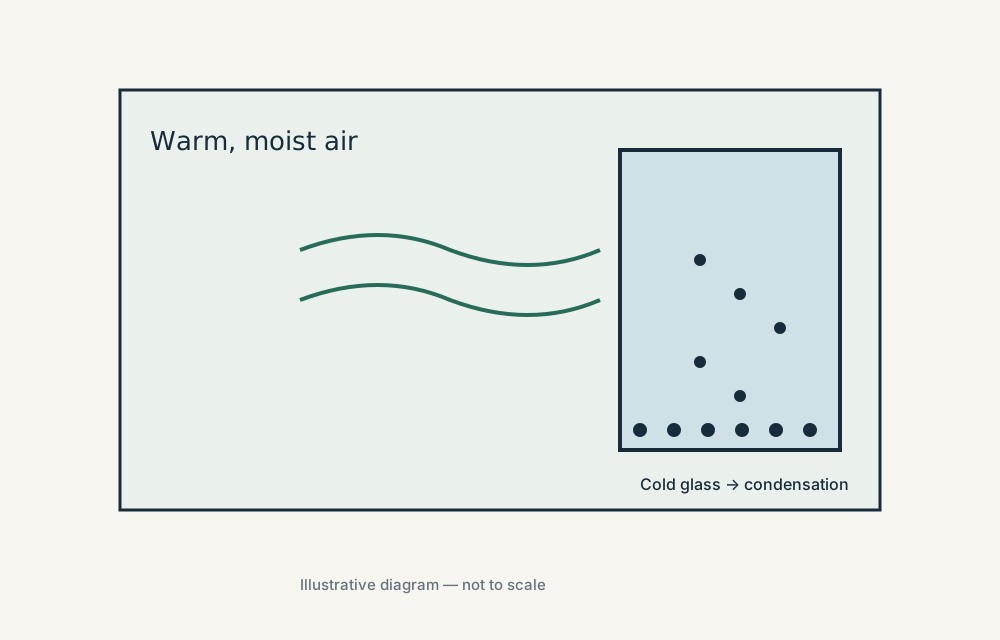
Condensation happens when warm air carrying water vapour touches a surface cold enough to cool that air below its dew point. The air can no longer hold all its moisture, so water is released onto the surface as droplets. It is driven by three things together: moisture-laden indoor air, cold surfaces, and too little ventilation to carry the moisture away.
Key takeaways
- Condensation needs three things at once: moist air, a cold surface, and poor ventilation.
- Warm air holds more water vapour than cold air, so cooling air releases moisture.
- The 'dew point' is the temperature at which air becomes saturated and water forms.
- Everyday activities — cooking, bathing, drying washing, even breathing — add litres of moisture to indoor air daily.
- It is the most common cause of damp and mould in UK homes, and usually the most affordable to manage.
Condensation is the most common cause of damp in UK homes, yet it is also the most misunderstood. Unlike a leak, nothing is broken. It is simply physics playing out on a cold winter morning — and once you understand the mechanism, the cure becomes obvious.
The basic science: warm air holds more water
Air always contains some water vapour. The warmer the air, the more vapour it can hold. Think of warm air as a sponge that expands when heated: a warm room can carry a large amount of invisible moisture without any sign of it.
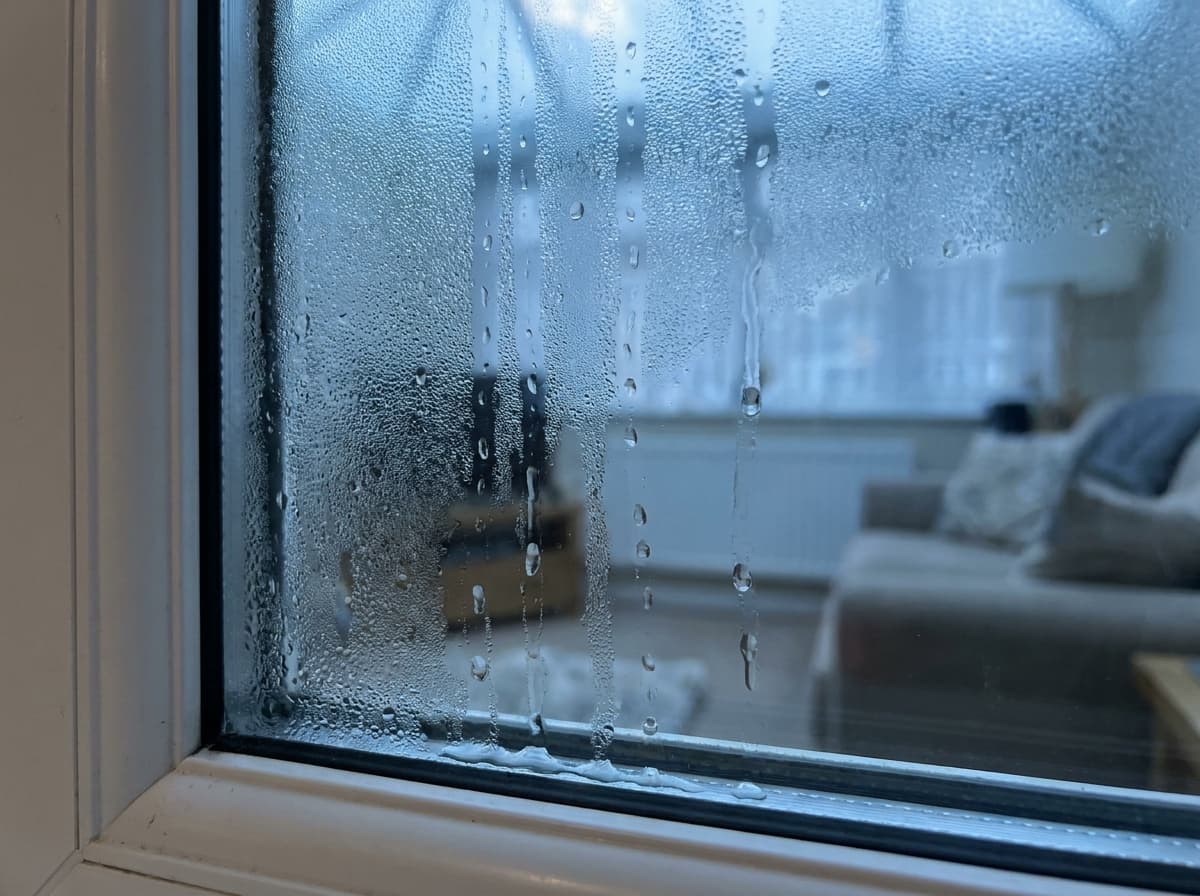
When that warm, moist air cools down — for example when it drifts against a cold window or an uninsulated external wall — the "sponge" shrinks. It can no longer hold all the water it was carrying, so the excess is released as liquid water on the cold surface. That is condensation.
This is exactly why a cold glass of water "sweats" on a warm day, and why your bathroom mirror fogs up after a shower.
The dew point: the temperature where water appears
The dew point is the specific temperature at which air becomes fully saturated and starts to release moisture. If a surface in your home is colder than the dew point of the surrounding air, condensation will form on it.
Two factors set the dew point:
- How much moisture the air already holds (its relative humidity).
- How warm the air is.
Humid air has a high dew point, so it only needs to cool a little before water forms. Drier air has a low dew point and can touch quite cold surfaces without trouble. This is the single most useful idea in controlling condensation: you are always trying to keep surfaces warmer than the dew point, or keep the dew point lower than your surfaces.
Tip
You can estimate the dew point for your own room using a thermometer and a humidity reading. Our dew point calculator does the maths for you and shows how close your surfaces are to the point where condensation forms.
The three ingredients, together
Condensation only becomes a problem when three things combine:
- Moisture-laden air — produced by normal daily life.
- Cold surfaces — single-glazed windows, thermal bridges, unheated rooms, north-facing walls.
- Poor ventilation — so the moist air lingers instead of being replaced with drier air.
Remove or reduce any one of the three and the balance tips back in your favour. That is why the proven fixes are always a combination of ventilating, heating and reducing moisture at source.
Where the moisture actually comes from
A typical household adds a surprising amount of water to the indoor air every single day, entirely through ordinary activities:
| Activity | Why it adds moisture |
|---|---|
| Cooking and boiling | Steam from pans and kettles |
| Showering and bathing | Large volumes of warm water vapour |
| Drying washing indoors | Every wet load releases its water into the air |
| Unvented tumble dryers | Pump moisture directly into the room |
| Breathing and perspiration | A sleeping household adds moisture overnight |
| Houseplants and aquariums | Continuous slow evaporation |
None of these are mistakes — they are just normal life. The goal is not to stop them, but to manage the moisture they create.
Why it is worse in winter
In winter, everything lines up against you. Surfaces are much colder, so their temperature often drops below the dew point. We ventilate less because we do not want to lose heat. And we spend more time indoors cooking, bathing and drying clothes inside. The result is the classic winter picture: streaming windows in the morning and black spot mould appearing in cold corners.
What this means for fixing it
Because condensation is about the relationship between moisture, temperature and ventilation, you have three levers:
- Reduce moisture at source (lids on pans, extractor fans, dry washing outside or in a vented space).
- Keep surfaces warmer with consistent low background heat and, where possible, better insulation.
- Ventilate so humid air is replaced before it can settle on cold surfaces.
For the full method, see how to stop condensation. To understand how condensation differs from a true building fault, read condensation vs damp.
Try a related tool
Frequently asked questions
Not usually. Unlike a leak or rising damp, condensation is not caused by a building defect — it is the natural result of warm, moist air meeting cold surfaces. That said, very cold surfaces caused by missing insulation or thermal bridging can make a home far more prone to it.
Sources
- GOV.UK: Understanding and addressing the health risks of damp and mould in the home · England · accessed 27 October 2026
- NHS: Can damp and mould affect my health? · UK · accessed 27 October 2026
DampSense Editorial Team
Research & editorial
Our editorial team researches UK building-moisture topics using government guidance, public-health sources and established building-science references. We write to help homeowners and tenants make informed decisions, and we flag where professional assessment is needed.
Credentials & limitations: Research-led editorial team. We are not chartered surveyors; our guides are general information, not a professional building survey.