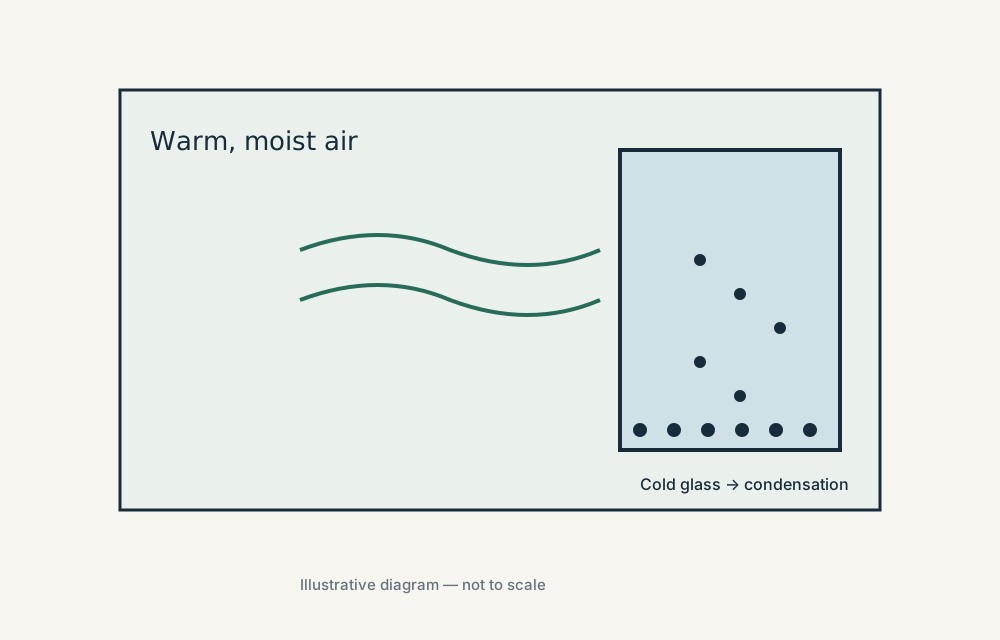
Condensation
Condensation vs Damp: How to Tell Them Apart
People often treat 'condensation' and 'damp' as opposites, but condensation is actually one type of damp. The distinction that matters is what is causing the moisture.
Disclosure: Some links may be affiliate links. If you buy through them we may earn a commission at no extra cost to you. This never affects which products we feature. Recommendations are based on published specifications and research, not hands-on lab testing. See our affiliate disclosure.
In short
Condensation is itself a type of damp — the type caused by moisture in the indoor air settling on cold surfaces. The phrase 'condensation vs damp' usually means condensation versus a building fault such as penetrating or rising damp. Condensation is managed with ventilation and heating; building-fault damp needs the physical defect repaired.
Key takeaways
- Condensation is a type of damp, not the opposite of it.
- The useful question is: is the moisture coming from the air inside, or from water getting into the fabric?
- Condensation is managed by changing conditions; penetrating and rising damp need repairs.
- Treating a leak as condensation — or vice versa — wastes money and leaves the real problem unsolved.
It is one of the most common sources of confusion in home maintenance. People say they have "damp, not condensation" or ask whether a patch is "just condensation". In truth, condensation is one type of damp. What people are really trying to work out is whether the moisture is coming from the air inside the home or from water entering the building fabric — because the fixes are completely different.
For a full overview of the main types, see what is damp.
The real distinction
| Condensation | Penetrating / rising damp | |
|---|---|---|
| Source of moisture | Water vapour in the indoor air | Water entering from outside or the ground |
| Typical location | Cold surfaces, corners, windows, behind furniture | A defined patch (penetrating) or low on the wall with a tide mark (rising) |
| Timing | Worse in winter and on cold mornings | Penetrating worsens after rain; rising is fairly constant |
| Water on glass | Common | No |
| The fix | Ventilation, heating, moisture control | Repair the physical defect |
How to tell which you have
Ask three questions:
- Where is it? Condensation clusters on cold surfaces and in corners and shows on windows. A single wet patch away from any cold bridge, or damp rising from the skirting, points to a building fault.
- When is it worse? Condensation peaks on cold winter mornings. Penetrating damp flares during and after heavy rain. Rising damp tends to sit there year-round.
- Is there water on the glass? Droplets on windows are a strong signal of condensation.
Important
Low-level wall damp is frequently misdiagnosed as rising damp when the real cause is condensation or a bridged damp-proof course. Be cautious if the company offering chemical injection is also the one making the diagnosis — consider an independent assessment.
Why the difference matters so much
The treatments do not overlap:
- Condensation responds to changing the conditions — more ventilation, consistent heat, less moisture in the air. It costs little and you can often make progress yourself. See how to stop condensation.
- Penetrating and rising damp respond only to repair — fixing the gutter, render, roof or damp-proof course that is letting water in. No amount of ventilation will dry out a wall that water keeps entering.
Spend money on the wrong one and you get the worst of both: an expensive, disruptive job that does not solve the problem, while the real cause carries on.
When both are present
Homes often have more than one issue at once — condensation in the bedrooms and a leaking gutter causing a localised penetrating patch, for instance. If a patch does not fit the condensation pattern, treat it as a possible building fault and investigate the fabric before assuming it is "just condensation".
Frequently asked questions
Yes. Condensation is one of the three main types of household damp, alongside penetrating and rising damp. It is distinctive because the moisture comes from the indoor air rather than from water entering the building.
Sources
- GOV.UK: Understanding and addressing the health risks of damp and mould in the home · England · accessed 27 October 2026
DampSense Editorial Team
Research & editorial
Our editorial team researches UK building-moisture topics using government guidance, public-health sources and established building-science references. We write to help homeowners and tenants make informed decisions, and we flag where professional assessment is needed.
Credentials & limitations: Research-led editorial team. We are not chartered surveyors; our guides are general information, not a professional building survey.