Damp
What Is Damp in a House?
Damp is a catch-all term for unwanted moisture in a building. The three main types in UK homes behave differently — and the right fix depends entirely on which one you have.
In short
Damp is unwanted moisture in a building's structure or air. In UK homes it almost always falls into one of three types: condensation (by far the most common), penetrating damp (water getting in from outside through a defect), or rising damp (groundwater rising through the base of a wall). Correctly identifying the type is essential, because each needs a different fix.
Key takeaways
- There are three main types of household damp: condensation, penetrating and rising.
- Condensation is the most common cause of damp and mould in UK homes.
- Rising damp is real but over-diagnosed — rule out other causes first.
- Treating the wrong type wastes money and leaves the real problem unsolved.
Damp simply means unwanted moisture — either held in the fabric of the building (walls, floors, ceilings) or carried in the indoor air. On its own, "damp" is not a diagnosis. It is a symptom, and the first job is always to work out where the moisture is coming from.
The three main types of damp
Almost every damp problem in a UK home is one of three types, sometimes in combination.
1. Condensation
Condensation forms when warm, moisture-laden indoor air touches a cold surface — a window, an external wall, a cold corner — and releases its water. It is driven by everyday activities (cooking, washing, drying clothes indoors, even breathing) combined with cold surfaces and too little ventilation.
Condensation is the most common cause of damp and mould in UK homes. The tell-tale signs are water droplets on windows in the morning, mould in cold corners and behind furniture on external walls, and problems that are worse in winter.
2. Penetrating damp
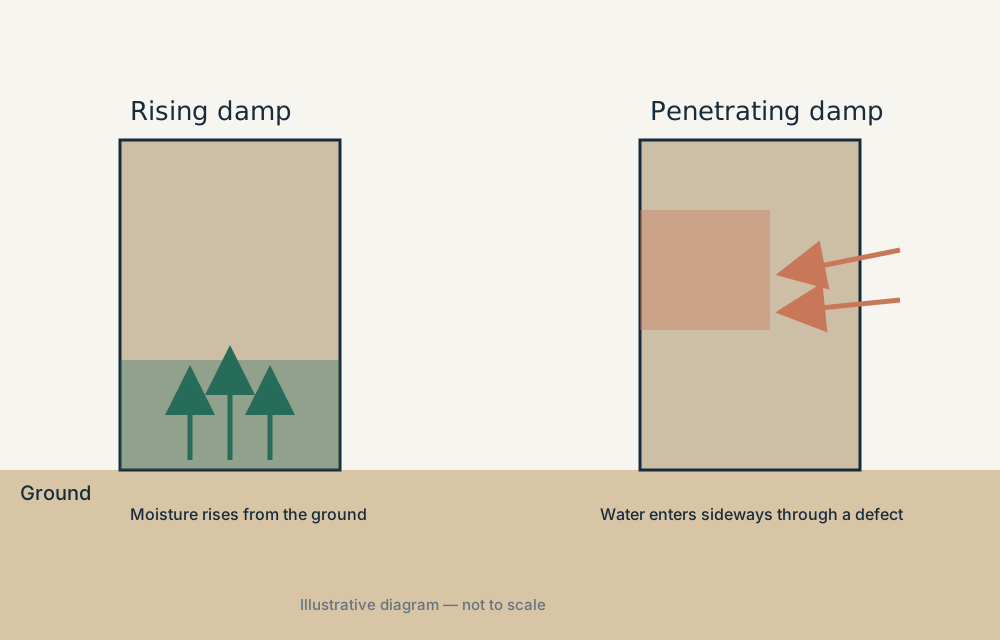
Penetrating damp is water getting in from outside through a defect in the building — a cracked render, failed pointing, a leaking gutter or downpipe, a roof problem, or a blocked cavity. It is usually localised to one patch, often worse after rain, and the damp mark may grow and shrink with the weather.
3. Rising damp
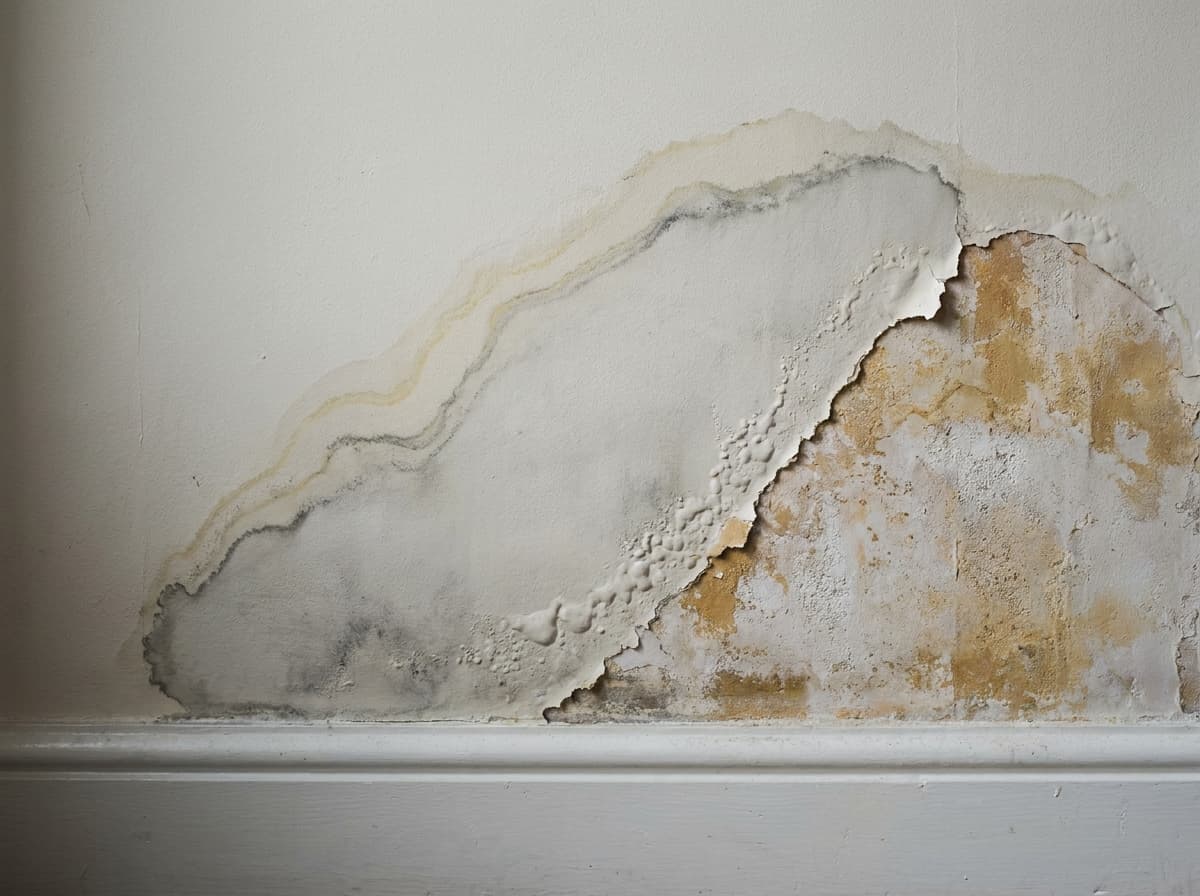
Rising damp is groundwater moving upwards through the base of a wall by capillary action, usually where a damp-proof course (DPC) is missing, failed or bridged. It is genuine, but far less common than it is diagnosed. Classic signs are a "tide mark" up to roughly a metre above floor level and salt deposits in the plaster.
Important
Low-level damp is frequently misdiagnosed as rising damp when the real cause is condensation or a bridged DPC. Be especially cautious if a company offering chemical injection is the one making the diagnosis.
How to tell the types apart
| Clue | Likely condensation | Likely penetrating | Likely rising |
|---|---|---|---|
| Worse after rain | No | Yes | No |
| Worse in winter / mornings | Yes | Sometimes | No clear pattern |
| Location | Cold surfaces, corners, windows | A localised patch, often high or mid-wall | Low on the wall, near skirting |
| Tide mark ~1m up | No | No | Sometimes |
| Water droplets on glass | Yes | No | No |
This is a guide, not a definitive test. Many homes have more than one problem at once, and a reliable diagnosis often needs on-site inspection with a moisture meter and, sometimes, deeper investigation.
Why correct diagnosis matters
The treatments are completely different. Improving ventilation and heating will transform a condensation problem but do nothing for a leaking gutter. Injecting a chemical DPC will not help if the real issue was condensation all along — yet it is an expensive, disruptive job. Getting the diagnosis right is the single most valuable thing you can do.
When to call a professional
Get an independent assessment — ideally from a surveyor who is not selling the treatment — if the damp is extensive, structural, recurring after previous "fixes", or you simply cannot identify the source. For a one-room condensation issue, you can often make real progress yourself first.
Try a related tool
Frequently asked questions
Condensation. It is driven by everyday moisture (cooking, washing, drying clothes indoors), cold surfaces and insufficient ventilation, and is usually the most affordable problem to manage.
Sources
- GOV.UK: Understanding and addressing the health risks of damp and mould in the home · England · accessed 27 October 2026
- NHS: Can damp and mould affect my health? · UK · accessed 27 October 2026
DampSense Editorial Team
Research & editorial
Our editorial team researches UK building-moisture topics using government guidance, public-health sources and established building-science references. We write to help homeowners and tenants make informed decisions, and we flag where professional assessment is needed.
Credentials & limitations: Research-led editorial team. We are not chartered surveyors; our guides are general information, not a professional building survey.