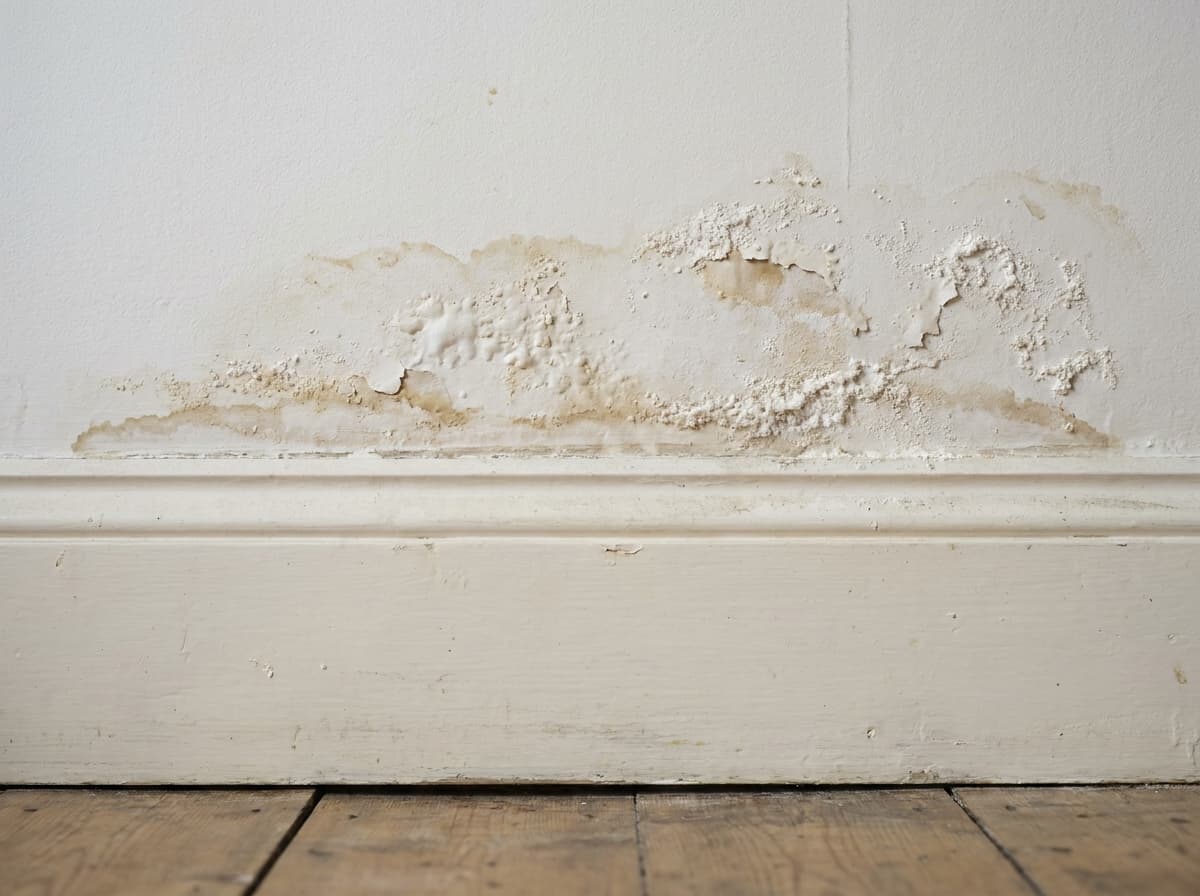
Rising Damp
Rising Damp vs Condensation
Rising damp and condensation are routinely confused, yet their cures are completely different. Here is how to tell which one you really have.
Disclosure: Some links may be affiliate links. If you buy through them we may earn a commission at no extra cost to you. This never affects which products we feature. Recommendations are based on published specifications and research, not hands-on lab testing. See our affiliate disclosure.
In short
Condensation forms when moist indoor air meets a cold surface, so it clusters on cold walls, corners and windows and brings black mould, worsening in winter. Rising damp is groundwater climbing a wall from below, leaving a low tide mark and salt deposits that do not change with the weather. Because they look similar near the floor, condensation is frequently misdiagnosed as rising damp — an expensive mistake, since the fixes are opposite.
Key takeaways
- Condensation is far more common than rising damp and is the usual real cause of low-level damp.
- Black mould and misted windows point to condensation, not rising damp.
- Rising damp leaves salt tide marks that ignore the weather; condensation tracks heating and ventilation.
- Misdiagnosis is costly — condensation treated as rising damp wastes money on chemical DPCs that do nothing.
These two are the most commonly confused forms of damp, and getting them mixed up is the single most expensive mistake in this field. They can produce similar stains low on a wall, but their causes — and cures — are opposites.
The core difference
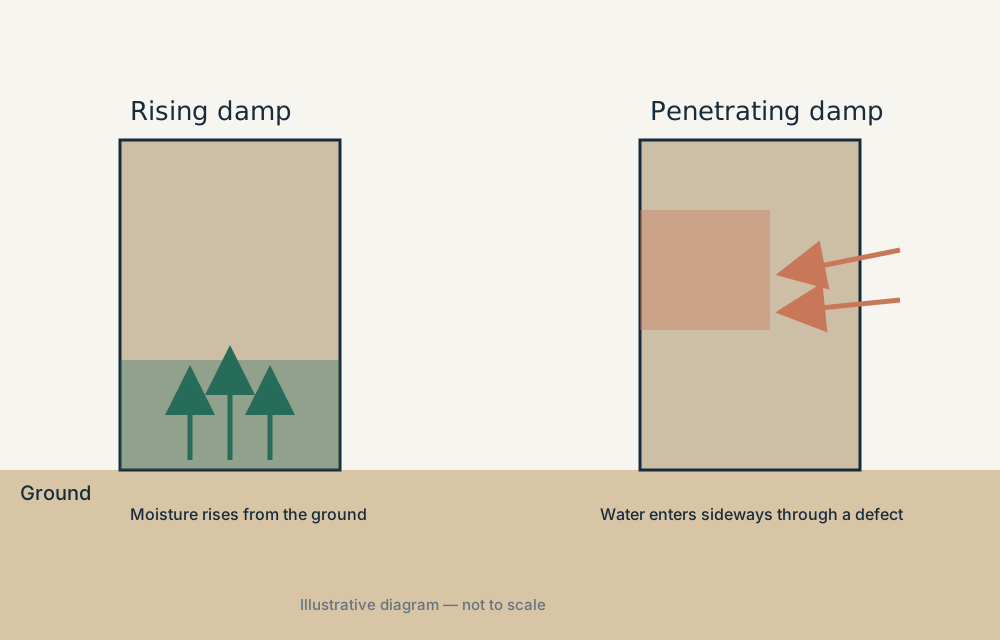
Condensation comes from inside. Warm, moisture-laden air from cooking, washing and drying meets a cold surface and deposits its water. The fix is managing moisture, ventilation and surface temperature.
Rising damp comes from below. Groundwater is drawn up through the wall by capillary action where a damp-proof course is missing, failed or bridged. The fix addresses the ground, the DPC or the bridging.
Important
Condensation is routinely misdiagnosed as rising damp. Because black mould and dampness both appear low on cold walls, it is easy to assume moisture is "rising" when it is actually settling out of the indoor air. Chemical DPC injection does nothing for a condensation problem — so be very wary if that is the proposed cure.
Side-by-side
| Clue | Condensation | Rising damp |
|---|---|---|
| Source | Moist indoor air | Groundwater below |
| Black mould | Common | Rare |
| Salt tide marks | No | Often |
| Worse in winter | Yes | No clear pattern |
| Water on windows | Yes | No |
| Worse after rain | No | No |
| Height on wall | Cold corners, any height | Low, up to ~1m |
| Typical fix | Ventilation, heating, moisture control | Fix bridging/DPC/ground |
Quick self-checks
- Is there black mould? Mould strongly favours condensation. Rising damp tends to stain and leave salt rather than grow mould.
- Are the windows misting up? Morning condensation on glass is a direct indicator of too much indoor moisture.
- Does it track the seasons? Problems that flare in winter and ease in summer are classic condensation.
- Is there a crisp salt tide mark that ignores the weather? That leans towards rising damp.
Because condensation depends on surface temperature and humidity, a dew point calculator can show whether your walls are cold enough for condensation to form — often settling the question before you spend anything.
Why the stakes are high
Treating condensation as rising damp means paying for chemical injection and replastering that cannot help, while the real problem — too much moisture and too little ventilation — continues unchecked. The mould comes back, and people wrongly conclude the "damp-proofing failed". Correct diagnosis is cheaper and far more effective. For the bigger picture, see what is damp and condensation vs damp.
When in doubt
Get an independent assessment from someone who does not sell the treatment, and use our Damp Diagnosis Assistant to structure what you are seeing first.
Try a related tool
Frequently asked questions
Black mould, misted windows and a winter pattern point to condensation. A low salt tide mark that stays constant whatever the weather points to rising damp. When low-level damp is in doubt, condensation is statistically the more likely cause.
Sources
- NHS: Can damp and mould affect my health? · UK · accessed 27 October 2026
DampSense Editorial Team
Research & editorial
Our editorial team researches UK building-moisture topics using government guidance, public-health sources and established building-science references. We write to help homeowners and tenants make informed decisions, and we flag where professional assessment is needed.
Credentials & limitations: Research-led editorial team. We are not chartered surveyors; our guides are general information, not a professional building survey.