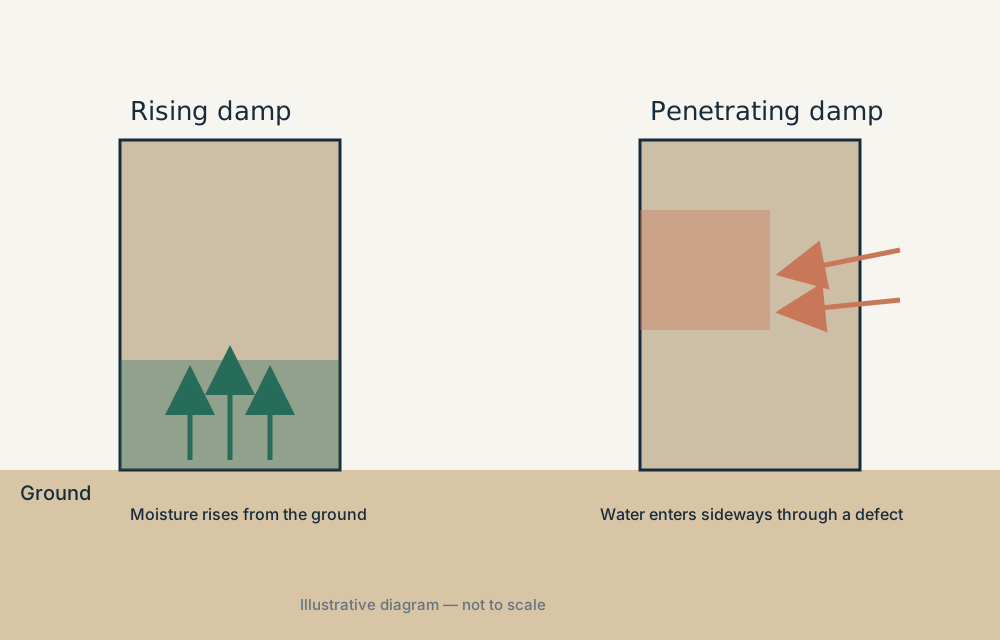
Rising Damp
The Signs of Rising Damp
How to recognise the classic signs of rising damp, and the alternative explanations to rule out before you accept the diagnosis.
In short
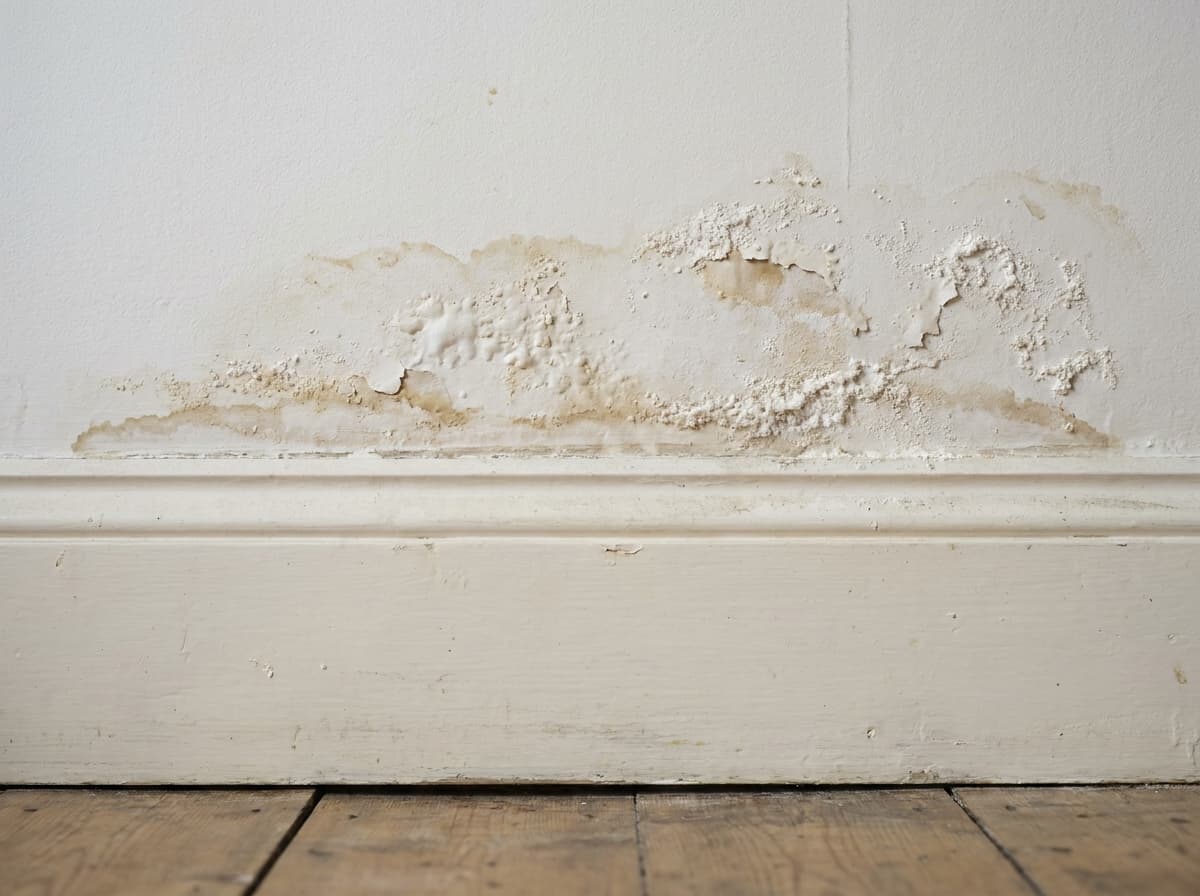
The classic signs of rising damp are a horizontal 'tide mark' up to about a metre above the floor, white or crystalline salt deposits in the plaster, perishing skirting boards and decoration low on the wall, and damp that does not change much with the weather. Because these signs overlap with condensation and bridged damp-proof courses, none of them is proof on its own.
Key takeaways
- Look for a tide mark and salt deposits low on the wall, up to roughly a metre high.
- Rising damp does not worsen noticeably after rain — that pattern points to penetrating damp.
- Mould, by contrast, usually signals condensation rather than rising damp.
- No single sign is conclusive; weigh several together and rule out cheaper causes first.
Rising damp has a fairly distinctive signature, but every one of its signs can be produced by something else. Treat the list below as a checklist of clues, not a diagnosis.
The tell-tale signs
A tide mark low on the wall
The most recognisable sign is a tide mark — a stained, often yellow-brown horizontal band — running along the wall up to roughly a metre above floor level. It marks the maximum height the groundwater has reached before evaporating.
Salt deposits in the plaster
As groundwater evaporates at the wall surface it leaves behind hygroscopic salts carried up from the ground. These show as white, fluffy or crystalline patches, and because they attract moisture from the air they can keep a wall feeling damp even after the source is dealt with.
Perished skirting, plaster and decoration
Low-level damp tends to blow plaster, lift paint and cause skirting boards to rot or crumble. Wallpaper may peel from the bottom upwards.
Damp that ignores the weather
Rising damp is fed by groundwater, so it stays fairly constant regardless of rainfall. If a patch clearly worsens a day or two after heavy rain, suspect penetrating damp instead.
Note
Mould growth is not a typical sign of rising damp. Black mould on walls and in corners almost always points to condensation. If mould is your main symptom, start with rising damp vs condensation.
What is often mistaken for rising damp
| What you see | Could be rising damp | More likely explanation |
|---|---|---|
| Tide mark ~1m up | Possibly | Historic leak or bridged DPC |
| Black mould in corners | Unlikely | Condensation |
| Damp worse after rain | No | Penetrating damp |
| High external ground level | Bridging, not true rising | Raised path, patio or border |
A very common scenario is a bridged DPC: a patio, path or flower bed built up above the damp-proof course, letting wet ground feed the wall. The symptoms mimic rising damp, but the fix is simply lowering the ground level — no chemical treatment required.
Confirming before you spend
Because the signs overlap so heavily, confirmation matters.
- Note where the damp sits and whether it has a clear horizontal top edge.
- Track whether it changes with the weather over a couple of weeks.
- Check the external ground level against the DPC.
- Get an independent assessment before paying for any treatment.
Our Damp Diagnosis Assistant walks through these questions. And remember the golden rule: be wary when the diagnosis and the sales pitch come from the same company.
Try a related tool
Frequently asked questions
Typically a stained horizontal tide mark up to about a metre up the wall, with white salt deposits, perished plaster and rotting skirting. It stays fairly constant whatever the weather.
Sources
- GOV.UK: Understanding and addressing the health risks of damp and mould in the home · England · accessed 27 October 2026
DampSense Editorial Team
Research & editorial
Our editorial team researches UK building-moisture topics using government guidance, public-health sources and established building-science references. We write to help homeowners and tenants make informed decisions, and we flag where professional assessment is needed.
Credentials & limitations: Research-led editorial team. We are not chartered surveyors; our guides are general information, not a professional building survey.