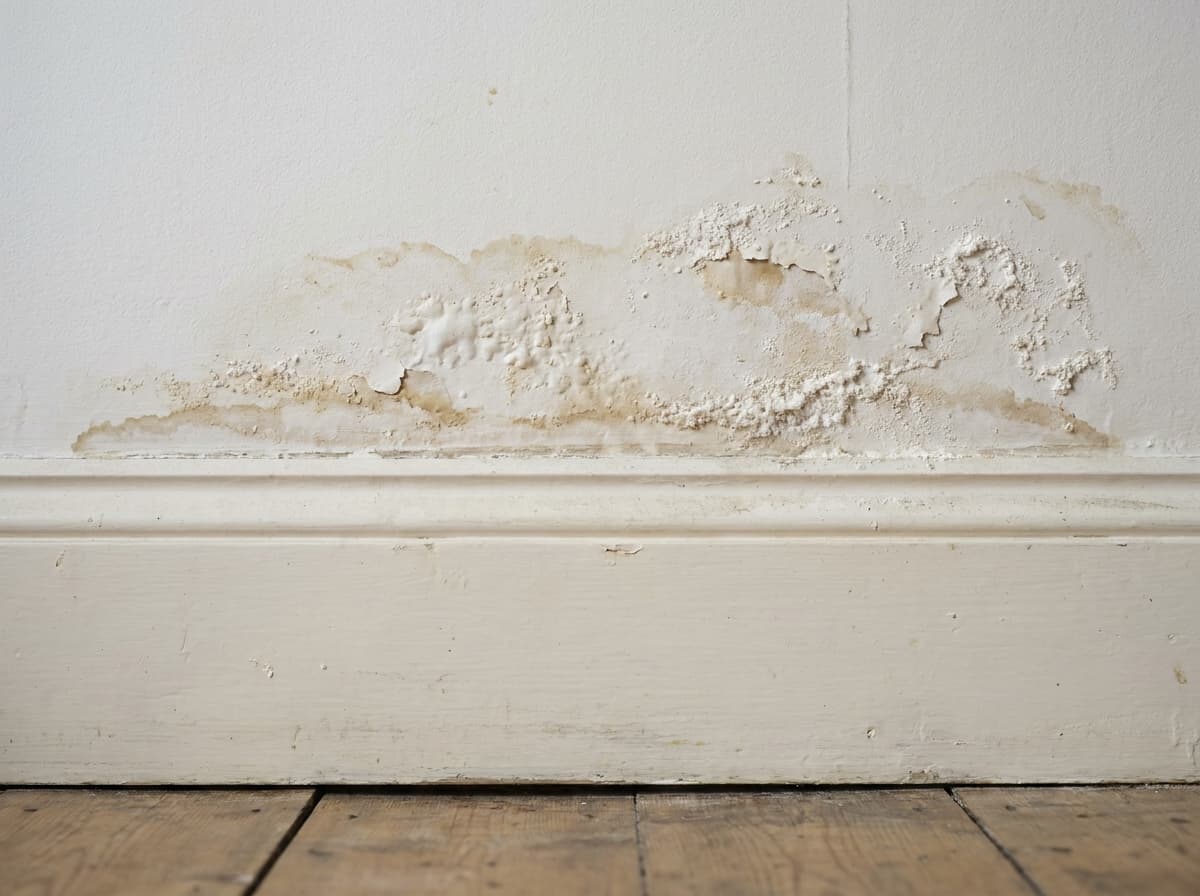
Rising Damp
What Is Rising Damp?
Rising damp is groundwater moving up through the base of a wall. It is a genuine phenomenon, but far rarer than the number of diagnoses suggests.
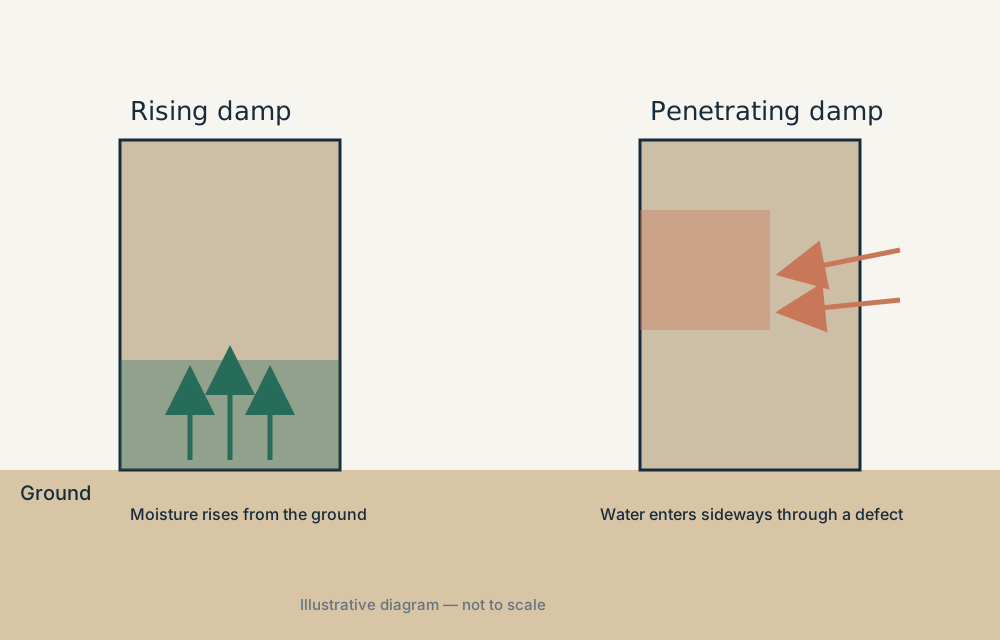
In short
Rising damp is groundwater drawn upwards through the porous structure of a wall by capillary action, typically where a damp-proof course (DPC) is missing, has failed, or has been bridged. It is a real phenomenon, but it is diagnosed far more often than it genuinely occurs — most low-level damp in UK homes turns out to be condensation or a bridged DPC rather than true rising damp.
Key takeaways
- Rising damp is groundwater rising through a wall by capillary action, usually to no more than about a metre.
- It is genuine but heavily over-diagnosed; condensation and bridged DPCs are far more common culprits.
- A missing, failed or bridged damp-proof course is the underlying mechanism.
- Be cautious when the company diagnosing rising damp is also the one selling chemical injection.
Rising damp is moisture from the ground moving upwards through the base of a wall. Porous building materials — brick, stone, mortar and plaster — contain tiny interconnected pores, and water can travel through them by capillary action, the same effect that draws liquid up a paper towel. Where there is nothing to stop it, groundwater can climb a short way up a wall from below.
How rising damp works
Most buildings constructed since the late nineteenth century include a damp-proof course (DPC) — a water-resistant barrier built into the wall a little above ground level. Its job is to interrupt that capillary path so moisture cannot rise past it. Rising damp becomes possible when that barrier is:
- Missing — common in older or solid-wall properties built before DPCs were routine.
- Failed — an older slate or bitumen DPC that has cracked or degraded.
- Bridged — a path of moisture that goes around an intact DPC, for example a raised external ground level, a flower bed banked against the wall, or debris in a cavity.
Capillary rise is self-limiting. In practice, true rising damp rarely climbs more than about a metre, because gravity and evaporation balance the upward pull.
Why rising damp is over-diagnosed
This is the most important thing to understand. Rising damp is real, but the phrase is applied to a great many problems that are nothing of the sort.
Important
Low-level damp on a wall is often condensation or a bridged DPC rather than true rising damp. Be especially sceptical when the firm diagnosing rising damp is the same firm selling a chemical damp-proof course — that is a clear conflict of interest.
A cold internal wall near the floor is exactly where condensation and mould like to form, which is easily mistaken for moisture "rising". Equally, raising a patio or path above the DPC allows rain-soaked ground to feed moisture into the wall — a bridging defect that is cheap to correct and does not need chemical injection.
The classic signs
Genuine rising damp tends to show a recognisable pattern:
- A "tide mark" — a stained horizontal band — up to roughly a metre above floor level.
- Salt deposits (hygroscopic salts) left in the plaster as groundwater evaporates.
- Damp that does not vary much with rainfall, unlike penetrating damp.
- Skirting boards, plaster or decoration perishing low on the wall.
None of these is conclusive on its own. For a structured walk-through of the signs, see our guide to the signs of rising damp.
How it differs from other damp
| Feature | Rising damp | Penetrating damp | Condensation |
|---|---|---|---|
| Source | Groundwater below | Rain/water from outside | Indoor moist air |
| Height | Low, up to ~1m | Any height | Cold surfaces, corners |
| Worse after rain | No | Yes | No |
| Salt tide marks | Often | Sometimes | No |
If your damp is seasonal, worse in winter, or sits on cold surfaces and windows, read rising damp vs condensation before assuming the worst.
Getting a reliable diagnosis
Before accepting a rising damp diagnosis — and certainly before paying for treatment — get an independent opinion, ideally from a surveyor who does not sell the remedy. Our Damp Diagnosis Assistant can help you structure what you are seeing and rule out the common alternatives first.
Try a related tool
Frequently asked questions
It exists, but it is much rarer than it is diagnosed. Most low-level damp turns out to be condensation or a bridged damp-proof course. Treat a rising damp diagnosis with healthy scepticism, especially from a company that also sells the cure.
Sources
- Historic England: Energy Efficiency and Historic Buildings · England · accessed 27 October 2026
DampSense Editorial Team
Research & editorial
Our editorial team researches UK building-moisture topics using government guidance, public-health sources and established building-science references. We write to help homeowners and tenants make informed decisions, and we flag where professional assessment is needed.
Credentials & limitations: Research-led editorial team. We are not chartered surveyors; our guides are general information, not a professional building survey.