Rising Damp
Treating Rising Damp
A sceptical, practical guide to treating rising damp — starting with the cheap fixes most people actually need, and keeping chemical injection in proportion.
In short
The right treatment for rising damp depends entirely on the real cause. In many cases the problem is a bridged damp-proof course, which is fixed cheaply by lowering external ground levels or clearing debris — no chemicals needed. A chemical injection damp-proof course is sometimes appropriate where a DPC is genuinely missing or failed, but it should never be the automatic default, and it should not be sold by the same company that made the diagnosis.
Key takeaways
- Correct diagnosis comes before any treatment — most 'rising damp' needs no chemical DPC.
- Fix bridging first: lower raised ground, clear cavities, repair leaks.
- Chemical injection DPCs have a role but are over-sold; treat them as a last resort.
- Never let the firm diagnosing the problem also be the one selling the cure.
There is a tempting, expensive answer to rising damp — chemical injection — and a cheaper, less glamorous one that works far more often. This guide starts from the cheaper end on purpose.
Step one: confirm the diagnosis
No treatment is worth paying for until you are confident what you are treating. A great deal of money is wasted injecting chemical damp-proof courses into walls whose damp was never rising in the first place.
Important
Get an independent diagnosis from a surveyor who does not sell treatment. A company that both diagnoses rising damp and sells the chemical cure has an obvious financial interest in finding it.
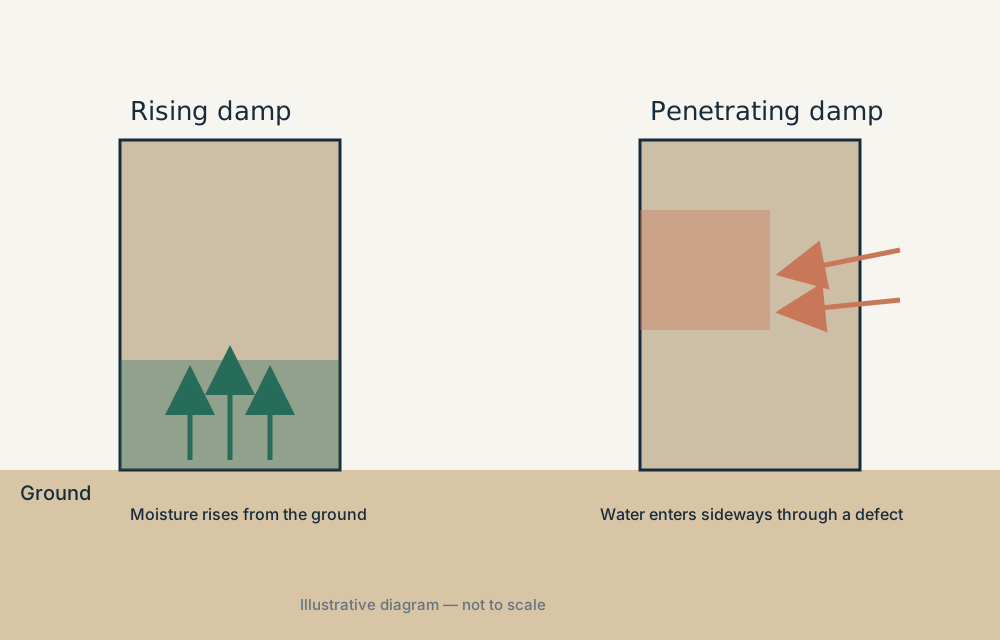
Rule out condensation and penetrating damp first — see rising damp vs condensation — and check whether an intact DPC is simply being bridged.
Step two: fix the cheap, common causes
For a large share of cases, this is the whole job:
- Lower raised ground levels. A path, patio or border built up above the DPC feeds the wall. Reinstating a clear gap below the DPC often solves it.
- Clear bridged cavities. Mortar droppings or debris in a cavity can carry moisture across. Clearing them removes the path.
- Repair leaks and drainage. A leaking gully, downpipe or underground drain near the wall base mimics rising damp perfectly.
None of this needs chemicals, and it addresses the actual mechanism rather than masking it.
Step three: consider a DPC only if genuinely needed
Where a building genuinely has no DPC, or one that has demonstrably failed, options include:
- Chemical injection DPC — a water-repellent cream or fluid injected into the mortar bed to form a new barrier. This is the mainstream remedial-industry approach. It can work, but results depend heavily on wall type and workmanship, and it is routinely sold where it is not needed.
- Physical DPC insertion — cutting a barrier into the wall. Effective but highly disruptive and expensive, usually reserved for specific cases.
For older solid-wall and period properties, aggressive "tanking" and impermeable treatments can trap moisture and cause more harm than good; breathable approaches are generally preferred. See Historic England's guidance on breathability before treating a period wall.
About replastering
After any genuine rising damp treatment, salt-contaminated plaster is often removed and replaced. Be aware that replastering alone does not cure rising damp — it only hides the symptoms if the source is still active. Where salts are the main ongoing issue, salt-retardant plaster systems may be specified.
Indicative costs
The figures below are indicative ranges for 2026 only, to give a sense of scale. They are not quotations and have not been independently surveyed. Always get multiple written quotes.
| Work | Indicative range (2026) |
|---|---|
| Lowering external ground level | Low hundreds of pounds |
| Chemical injection DPC (per wall/room) | Several hundred to low thousands |
| Replastering after treatment | A few hundred pounds per wall |
Use our Damp Treatment Cost Calculator to explore scenarios, and treat any single quote with caution until you have compared a few.
The sensible order of priority
- Confirm the cause independently.
- Fix bridging, leaks and drainage first.
- Only then consider a DPC, and only where one is genuinely absent or failed.
- Choose breathable methods for period and solid-wall homes.
Try a related tool
Frequently asked questions
No — and most of the time it does not. Many cases are bridged DPCs or leaks fixed without any chemicals. Chemical injection has a place only where a DPC is genuinely missing or failed, and it is widely over-sold.
Sources
- Historic England: Energy Efficiency and Historic Buildings · England · accessed 27 October 2026
DampSense Editorial Team
Research & editorial
Our editorial team researches UK building-moisture topics using government guidance, public-health sources and established building-science references. We write to help homeowners and tenants make informed decisions, and we flag where professional assessment is needed.
Credentials & limitations: Research-led editorial team. We are not chartered surveyors; our guides are general information, not a professional building survey.