
Products
How to Choose the Best Dehumidifier for Damp and Condensation
A dehumidifier can transform a condensation problem — but only if you pick the right type for your home. Here is what the specifications actually mean and how to choose.
Disclosure: Some links may be affiliate links. If you buy through them we may earn a commission at no extra cost to you. This never affects which products we feature. Recommendations are based on published specifications and research, not hands-on lab testing. See our affiliate disclosure.
In short
For most UK homes a compressor (refrigerant) dehumidifier is the efficient all-rounder in heated living spaces, while a desiccant model works better in cold, unheated rooms such as garages, conservatories and utility spaces. Match the extraction rate and tank size to the room, and check the noise rating if it will run near living or sleeping areas.
Key takeaways
- The two main types are compressor (refrigerant) and desiccant — each suits different conditions.
- Compressor models are generally more energy-efficient in warm rooms; desiccant models cope better with the cold.
- Extraction rate (litres per day) is a rated figure under test conditions, not what you will see every day.
- Running cost depends on wattage and how long the unit runs, so estimate it before you buy.
- A dehumidifier manages symptoms — fixing ventilation, heating and any leaks tackles the cause.
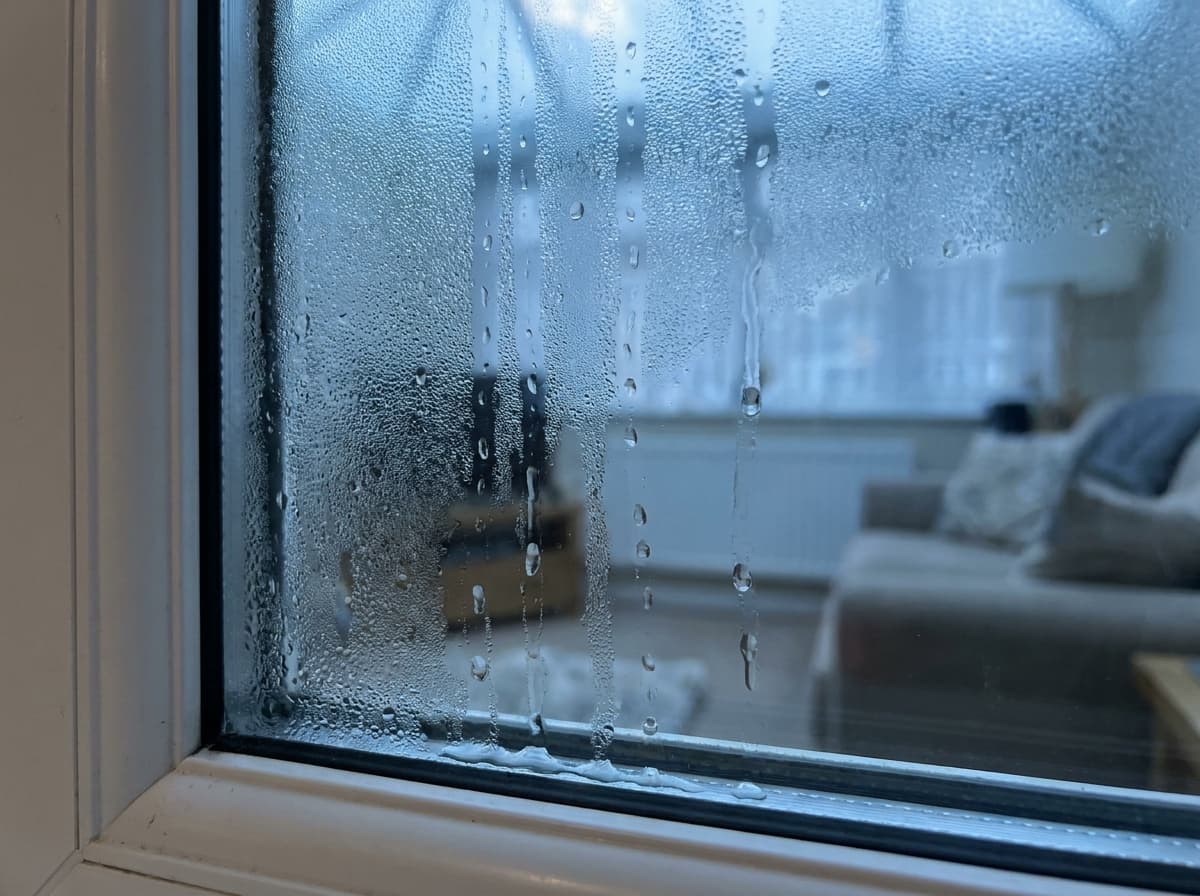
A dehumidifier pulls moisture out of the air, lowering indoor humidity so condensation and mould have less chance to form. It is one of the most useful tools for a condensation problem, but it is not a cure on its own — it works alongside better ventilation and heating, not instead of them.
The recommendations below are based on published manufacturer specifications and general research, not our own lab testing. Treat them as guidance on what to look for, then compare current models for yourself.
Compressor vs desiccant: the key decision
The single most important choice is the type of dehumidifier, because the two technologies behave very differently.
Compressor (refrigerant) dehumidifiers
A compressor model cools a coil so that moisture in the air condenses onto it and drips into the tank — the same principle as a fridge. They are generally more energy-efficient in warmer rooms and tend to have higher rated extraction, which is why they are the usual choice for heated living areas and bedrooms. Their weakness is cold: efficiency falls off noticeably below roughly 15°C, so they are less suited to unheated spaces.
Desiccant dehumidifiers
A desiccant model passes air over a moisture-absorbing material and then gently warms it to release the water. They work well in cold conditions, run more quietly, are usually lighter, and give off a little warmth. The trade-off is that they often draw more power for the same amount of water removed in a warm room. They suit garages, conservatories, caravans and unheated utility rooms.
Tip
If the room you are treating is cold and unheated for much of the year, a desiccant model is usually the safer bet. For a heated home, a compressor model is typically the efficient all-rounder.
What the specifications mean
Extraction rate (litres per day)
This is the headline figure — but it is measured under specific test conditions (a set temperature and humidity) that your home will rarely match. Real-world extraction is almost always lower. Use it to compare models of the same type, not as a promise of daily output.
Tank size and drainage
A larger tank means fewer trips to empty it, but also a heavier unit. If you will run the dehumidifier continuously — for example, to dry a room after a leak — look for a continuous drainage option, where a hose carries water straight to a drain so you never have to empty the tank.
Noise
Noise is rated in decibels (dB). A quieter unit matters a great deal if it will run overnight or in a room you use. Desiccant models are often quieter than compressor models, though this varies by product.
Features worth having
- A humidistat that lets you set a target humidity and switches the unit off when it is reached, saving energy.
- A laundry or boost mode for drying clothes indoors.
- An auto-restart so it resumes after a power cut.
- A clear tank-full cut-off so it stops safely when full.
Comparison by type
| Feature | Compressor (refrigerant) | Desiccant |
|---|---|---|
| Best for | Heated living rooms, bedrooms | Cold or unheated spaces |
| Cold-weather performance | Falls off below ~15°C | Works well in the cold |
| Energy use in warm rooms | Generally more efficient | Often draws more power |
| Noise | Typically higher | Often quieter |
| Weight | Usually heavier | Usually lighter |
| Gives off warmth | Minimal | Yes, a little |
This table compares the two categories by typical behaviour and intended use. It is not a ranking of individual products and contains no test scores or prices.
Sizing it to your home
A small bedroom needs far less capacity than an open-plan living space or a whole house recovering from a leak. As a rule of thumb, match a higher extraction rating to larger or damper spaces, but do not assume "bigger is always better" — an oversized unit in a small room simply costs more to buy and run.
Estimating running cost before you buy
Running cost comes down to the unit's wattage and how many hours a day it runs. A model with a humidistat will cycle off once your target humidity is reached, which can cut running hours substantially. You can estimate the cost for a given model with our dehumidifier running cost calculator.
Well-known brands
You will come across names such as Meaco, EcoAir, De'Longhi and Pro Breeze, among others. We mention these only as examples of brands commonly sold in the UK — this is not an endorsement, and you should compare the specifications of current models rather than relying on the badge.
The bigger picture
A dehumidifier is a powerful tool against condensation, but it treats a symptom. If you want the problem to stay away, combine it with good ventilation and consistent heating, and read our guide on how to stop condensation. If the damp is actually a leak or penetrating damp, a dehumidifier will not fix the defect — the repair must be done.
Try a related tool
Frequently asked questions
They reduce the airborne moisture that drives condensation and surface mould, which helps keep surfaces dry so mould is less likely to return. They do not remove existing mould (that needs cleaning) and they do not fix leaks or penetrating damp, which require physical repair.
Sources
- Energy Saving Trust: Energy Saving Trust · UK · accessed 27 October 2026
DampSense Editorial Team
Research & editorial
Our editorial team researches UK building-moisture topics using government guidance, public-health sources and established building-science references. We write to help homeowners and tenants make informed decisions, and we flag where professional assessment is needed.
Credentials & limitations: Research-led editorial team. We are not chartered surveyors; our guides are general information, not a professional building survey.