Damp Proofing
What Is Damp Proofing?
Damp proofing covers the barriers and measures that keep ground and external moisture out of a wall or floor. It only works when the right problem has been identified first.
In short
Damp proofing is any measure designed to stop unwanted moisture entering a building through its walls or floors — for example a damp-proof course, a damp-proof membrane, external repairs, or tanking a cellar. It is an umbrella term, not a single product, and the right measure depends entirely on an accurate diagnosis of where the moisture is actually coming from. Crucially, most everyday damp in UK homes is condensation, which damp proofing does not fix.
Key takeaways
- Damp proofing is an umbrella term for measures that keep ground or external moisture out of a building.
- The main physical elements are the damp-proof course (DPC) and damp-proof membrane (DPM).
- The correct measure depends on a correct diagnosis — rising, penetrating and condensation damp each need different responses.
- Most household damp is condensation, which damp proofing cannot cure; ventilation and heating are the answer there.
- Be wary of a single-product 'damp proofing' quote issued before anyone has diagnosed the cause.
Damp proofing is a broad term for anything that stops unwanted moisture getting into the fabric of a building — its walls and floors — or that controls moisture already present. It is not one product or one job. It covers physical barriers built into the structure, membranes, external repairs and, in some cases, specialist linings for below-ground rooms.
Because the word is used so loosely by contractors and in advertising, it helps to separate the genuine building measures from the marketing. The single most important point is this: damp proofing only works if it addresses the actual cause of the damp. Fitting a barrier against groundwater does nothing for condensation, and most damp in UK homes is condensation.
What damp proofing is trying to stop
Moisture reaches the inside of a home by three broad routes, and each needs a different response:
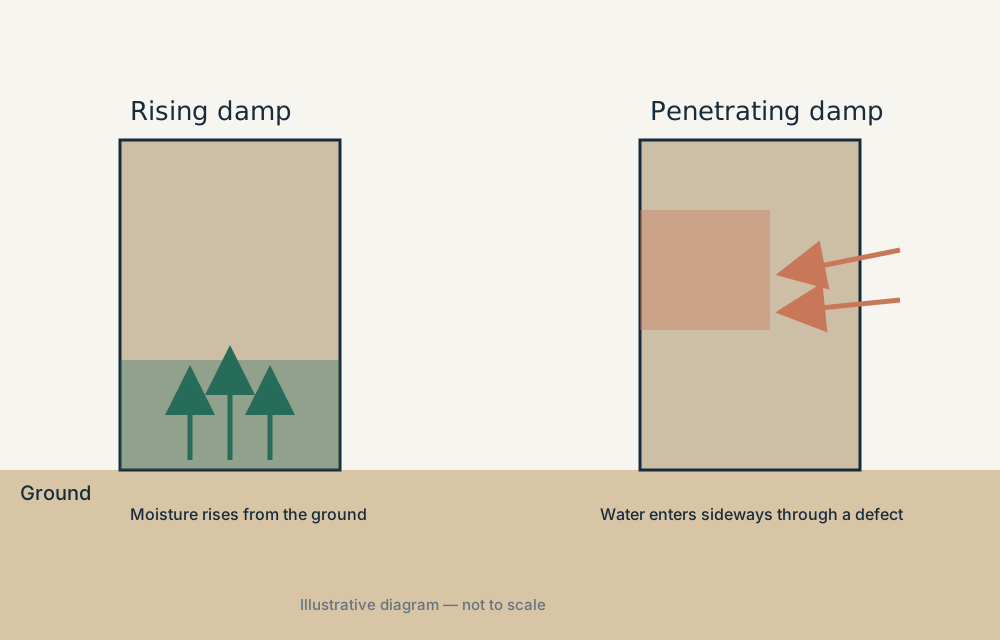
- From the ground, upwards — groundwater drawn up through a wall by capillary action. See what is rising damp.
- From outside, inwards — rain and external water pushing through walls, roofs or around openings. See what is penetrating damp.
- From inside, as vapour — warm, moist indoor air condensing on cold surfaces. See what is damp.
Only the first two are "damp proofing" problems in the traditional sense. Condensation is a ventilation, heating and lifestyle issue, and no amount of damp proofing will solve it.
Important
If a quote for "damp proofing" arrives before anyone has diagnosed why a wall is damp, treat it with caution. A measurement with a handheld meter is not a diagnosis, and chemical injection in particular is widely sold for problems it cannot fix.
The main damp-proofing methods
| Method | What it is | What it is for |
|---|---|---|
| Damp-proof course (DPC) | A horizontal barrier near the base of a wall | Stopping groundwater rising up the wall |
| Damp-proof membrane (DPM) | A sheet or liquid barrier under or over a floor | Stopping ground moisture coming up through floors |
| External repairs | Repointing, rendering, flashing, guttering | Keeping rain and external water out |
| Tanking | A waterproof lining to walls/floors | Keeping water out of cellars and basements |
| Cavity drainage | A membrane that manages water to a drain | Below-ground rooms where water cannot be excluded |
Each of these is explained in its own guide. The DPC is covered in the damp-proof course, chemical injection in damp-proof injection, and below-ground work in tanking.
Physical barriers versus added treatments
It is worth distinguishing the barriers built into a sound modern building from the treatments added later to older or defective ones:
- Built in: most homes built since roughly the late 1800s have a DPC in the walls and, in newer homes, a DPM in the floor. When these are intact and not bridged, they quietly do their job for the life of the building.
- Added later: chemical DPC injection, replastering with salt-resistant systems, tanking and membranes are all retrofit measures. They can be appropriate, but they are also the ones most often oversold.
Why diagnosis has to come first
A damp patch is a symptom, not a diagnosis. The same stain on a wall could be groundwater, a leaking gutter outside, a bridged DPC caused by a raised flower bed, or simple condensation on a cold spot. Each has a different — and very differently priced — remedy.
Getting this wrong is expensive. Injecting a chemical DPC into a wall that is actually suffering from condensation wastes money and leaves the real problem untouched. For older, solid-walled or period homes the risk is greater still, because the wrong treatment can trap moisture and cause damage (see Historic England's guidance below).
The sensible order is: observe the pattern, rule out the cheap and common causes, get an independent opinion where the cost is significant, and only then consider a physical intervention. Our Damp Diagnosis Assistant can help you structure what you are seeing before you call anyone out.
Who should do it
Minor external repairs — clearing gutters, lowering a raised path, repointing a small area — are often within reach of a competent DIYer or a general builder. Structural DPC work, tanking and basement conversions are specialist jobs. In every case, prefer an assessor who is independent of the firm selling the remedy, and get the diagnosis in writing before you commit.
Try a related tool
Frequently asked questions
No. A well-built, well-maintained home with an intact damp-proof course and good external repair usually needs no added damp proofing at all. Most damp complaints in UK homes are condensation, which is solved by ventilation and heating rather than by any damp-proofing product.
Sources
- Historic England: Energy Efficiency and Historic Buildings · England · accessed 27 October 2026
- GOV.UK: Damp and mould: understanding and addressing the health risks · England · accessed 27 October 2026
DampSense Editorial Team
Research & editorial
Our editorial team researches UK building-moisture topics using government guidance, public-health sources and established building-science references. We write to help homeowners and tenants make informed decisions, and we flag where professional assessment is needed.
Credentials & limitations: Research-led editorial team. We are not chartered surveyors; our guides are general information, not a professional building survey.